Team Dynamics
Does AI force us to rethink how teams work?
When every member of a team has a copilot, roles, rituals, and work distribution begin to deform. How do we recompose them?
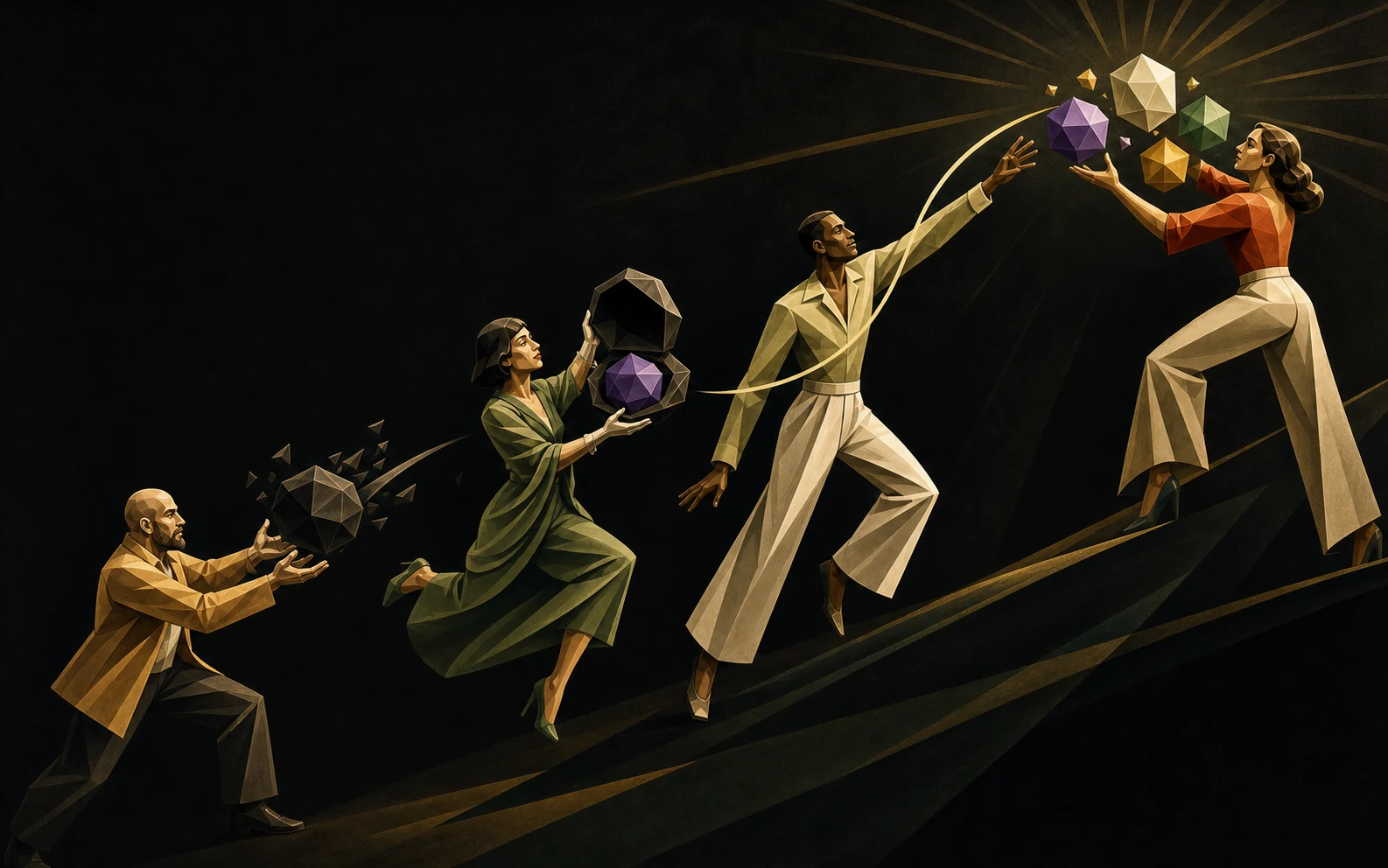
If every person on a team suddenly has access to an indefatigable, versatile, patient collaborator, what changes? This article maps the distortions observed in the field and offers a framework for recomposition.
The myth of individual gain
The dominant story presents AI as a multiplier of individual productivity. In the field, I see the opposite: the most durable gains happen at team level, when the team agrees to revisit its rituals - who drafts, who reviews, who decides, and when.
To understand why, you have to step back one level. Time is accelerating - the evidence is everywhere, every day. But that everyday truism hides a deeper, subtler, fundamentally more human reality. In our relentless pursuit of efficiency and productivity, we tend to treat acceleration as a purely quantitative phenomenon: more tasks completed in less time. That reductive view masks a far more fundamental transformation of our relationship to the world, to ourselves and - this is what concerns us here - to the way we collaborate as a team.
We are living through a silent revolution in how we think, create, and decide together. It does not announce itself through spectacular upheavals; it advances through a gradual, profound transformation of our cognitive processes. It plays out in the interstices of our daily interactions with technology, in how we learn to think with - and through - artificial intelligence systems.
This is not simply a story of disappearing jobs or automated tasks. Something deeper is happening: for the first time in human history, significant parts of our thinking - our reasoning, our decision-making, even our creativity - are moving out of our individual minds and becoming shared interactions with AI. This externalisation of our cognition is not mere task delegation. It is a redistribution of our collective intelligence, a new kind of relationship between human and machine.
The end of solitary intelligence
Traditionally, intelligence has always been a personal affair, internalised in each of us. We generated ideas, analysed problems, and shaped solutions individually, using our own brains. That view of intelligence as individual property has deeply shaped our understanding of creativity, innovation, and decision-making: each person was treated as an autonomous cognitive unit, able to think and create independently.
Collaboration, in that world, mostly meant communicating inner thinking outward - meetings, presentations, emails, documents. Those tools served as bridges between essentially separate minds: they let information flow, but they preserved the fundamentally individual nature of thought. Even in the closest-knit teams, cognition remained personal, shared only once it had been fully worked out in someone’s head.
Today, the very nature of human thinking is changing. Our intelligence is no longer confined to our heads; it is increasingly distributed across networks of humans and AI. We are not just writing prompts and receiving outputs from ChatGPT, Claude, or Le Chat: we are actively thinking and creating in dialogue with intelligent systems. This distributed cognition is not an upgraded form of collaboration. It is a transformation of what “thinking” means in a world where intelligence is no longer the monopoly of human brains.
The three dimensions of distributed cognition
The teams that genuinely benefit from this shift do not get there by accident. Three practices structure the way they work.
1. Explicit management of shared context
Managing context explicitly means deliberately capturing, documenting, and reusing the insights and decisions generated through interactions with AI. This practice ensures that collective intelligence accumulates instead of evaporating: it feeds productivity and improves the quality of decision-making. In an environment where thinking is distributed, context is no longer the mere backdrop to decisions - it becomes a full participant in the cognitive process.
That requires particular care in how we document and share our interactions with AI. Every prompt, every answer, every iteration becomes a piece of a larger puzzle, contributing to an augmented collective memory. And that memory is not static: it evolves and grows richer with every new interaction, until it forms a genuine ecosystem of shared knowledge.
2. The primacy of human judgment and taste
Prioritising human judgment and taste means recognising that AI can generate ideas quickly, but that the most critical - and most difficult - part of productive work remains evaluating, selecting, and building on those ideas. High-performing teams rigorously assess AI outputs against clear internal standards of quality, relevance, and strategic alignment.
The real challenge is no longer generating ideas - AI excels at that - but exercising informed judgment about them. That human judgment, fed by experience, intuition, and values, becomes the differentiating factor in the quality of the work produced. The teams that succeed are the ones that have built a strong culture of critical evaluation, where every AI output is treated as a starting point rather than a conclusion.
3. Intentional workflows
Intentional workflows mean defining clearly how team members interact with AI and with each other: who initiates prompts, who refines responses, who curates outputs, who integrates insights. This structural dimension is essential to turn individual AI usage into a genuine system of collective cognition.
Designing these workflows takes serious thought about how to combine each person’s skills and perspectives. It is not simply a matter of organising tasks; it is about shaping processes that let collective intelligence flourish, drawing the best from human and artificial capabilities alike.
The traps to avoid
Conversely, two bad practices are enough to hollow the whole approach out.
1. Treating AI superficially
Treating AI superficially means using it mainly as a quick shortcut or a convenience rather than as a meaningful strategic collaborator. Instead of engaging deeply with generated content and evaluating it critically, the team passively accepts surface-level outputs - and produces work that is shallow, inconsistent, or misaligned.
This trap often shows up as a purely instrumental use of the tools, with no real thought about how they fit into the team’s collective thinking processes. Teams that fall into it miss the chance to build a genuine cognitive relationship with AI: they settle for basic automation that never transforms how they work.
2. Substituting AI for strategic thinking
The second trap is treating AI outputs as finished strategic insights or end products, rather than as starting points for deeper human analysis. This reflex compromises the depth, originality, and coherence of the team’s strategic work.
Excessive confidence in AI’s capabilities can lead to a quiet abdication of responsibility: the machine’s suggestions get accepted uncritically, without the level of judgment that real strategic work demands. Teams that give in to this drift risk losing their capacity to think independently and creatively.
Learning to think together, again
We are living through something extraordinarily quiet. For hundreds of thousands of years, humans thought, solved problems, and created mainly inside their own heads - writing itself is a recent invention on the timescale of our species. Our ideas have always been personal, carefully shaped internally before being shared with others. That paradigm is ending right now, and a new one is beginning.
For the first time, our thoughts and our intelligence are starting to live partly outside ourselves, in the interactions between humans and AI. We are learning to think, to remember, and to create with something that is not human. This transformation is not merely technological; it is deeply philosophical. It is not simply about using a new technology: it is about relearning how we share ideas, make decisions, and trust one another. It asks us to reconsider our assumptions about ownership, responsibility, and creativity - the very foundations of our professional identity.
But there is a real opportunity here. Teams that approach this shift openly and deliberately, willing to gently let go of old habits, discover new ways of collaborating, innovating, and connecting. They find new depth and clarity in their work, rediscover the joy of exploring ideas, and solve problems with greater fluidity.
It takes patience, humility, and intent. We will not always get it right the first time, and that is fine. This transformation is not a destination but a continuous journey of adaptation. Because at the heart of it all, beyond the technology, beyond the efficiency, lies a simple human truth: how we work together shapes who we become together.
The change runs deep.
Four team roles to redraw
So what does each person become, concretely, once cognition is distributed? Here is the recomposition framework I propose:
- The writer becomes the editor-in-chief of their own first drafts.
- The reviewer becomes the judge of accuracy, not of form.
- The manager becomes the designer of shared prompts.
- The subject-matter expert becomes the source of truth that validates what AI cannot know.
This recomposition is neither automatic nor gentle. It has to be worked through. That is precisely what an AI Activation Sprint is for.
This article draws on inspiration and concepts from Nate B Jones, an AI expert.
Keep reading
Team Dynamics • 23 Jun 2026 • EN
Some of your employees are quietly sabotaging your AI rollout. They have their reasons.
When employees quietly undermine an AI rollout, the boardroom asks who. The useful question is why. Resistance is feedback that could not find a safer channel, and it is readable.

Team Dynamics • 21 Aug 2025 • EN
What if we held AI upside down?
A reversal of perspective: what if AI is not a tool to master, but a mirror that reveals our cognitive blind spots?