AI Adoption
The mistake organizations made with mobile in 2012 is the one they're making with AI in 2026
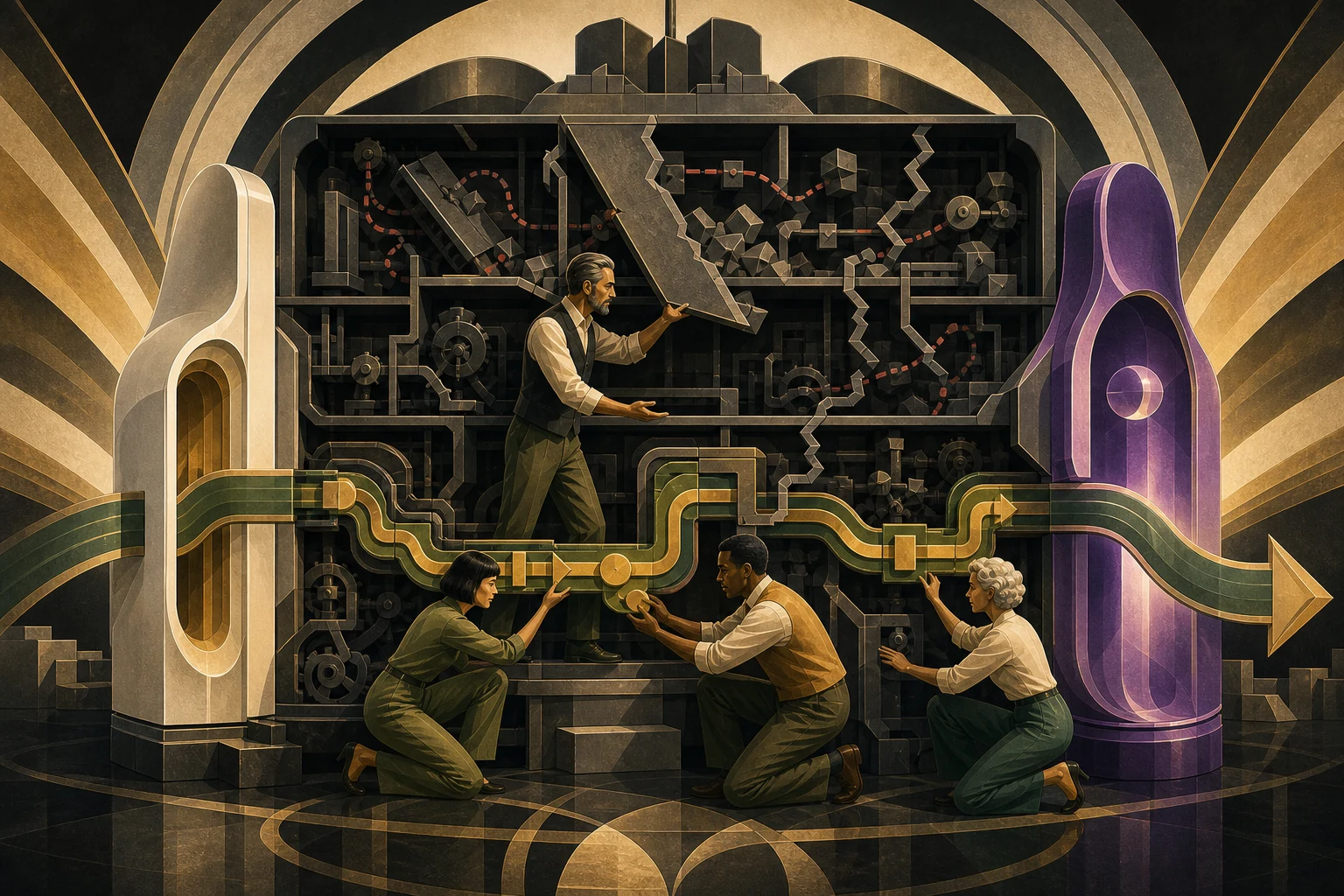
Replace mobile app with AI pilot and 2012 becomes 2026. A technology that changes how work flows cannot be adopted as an accessory to work that has not changed.
In the early 2010s, every board in Europe asked the same question: “What’s our mobile strategy?”
The standard answer was to build an app. A team was created — usually off to the side, often with an agency — and a year later the organization proudly had one. Downloads were counted, a press release went out, and everyone returned to business as usual.
Then came the uncomfortable discovery: the app wasn’t a strategy. It was a bolt-on. The customer who started a purchase on mobile couldn’t finish it in the store. The stock system didn’t know what the app promised. The processes behind the glass hadn’t changed at all. Organizations had added a channel without redesigning anything the channel touched.
I lived that correction from the inside. In Belgian retail, in telecom, in banking, the work of the following five years wasn’t “mobile” — it was untangling what mobile had exposed. At Carrefour, the real omnichannel question was never the app; it was which format serves which customer journey — Express, Market, hypermarket, drive, pickup, home delivery — and what had to change behind the interface to make any of those journeys coherent. The interface was the easy 10%. The operating model was the hard 90%.
The rerun, fourteen years later
Now replace “mobile app” with “AI pilot” and 2012 becomes 2026.
Organizations are deploying copilots and chatbots the way they once shipped apps: as bolt-ons to unchanged processes. A team off to the side. A proud announcement. Usage metrics that mostly measure curiosity. And underneath, workflows designed for a pre-AI world, untouched.
The industry has even given the resulting wall a name: the enterprise scaling gap — organizations stuck between experimentation and production because they layered agents onto existing processes instead of redesigning the processes themselves. Surveys back the sensation up: most executives report AI adoption challenges, and only a minority see significant ROI despite heavy investment.
None of this should surprise anyone who lived 2012. A technology that changes how work flows cannot be adopted as an accessory to work that hasn’t changed. Mobile forced organizations to rebuild journeys around the customer. AI forces something deeper: rebuilding workflows around a new division of labor between humans and machines — what each decides, what each verifies, where judgment sits. That’s not a tool rollout. That’s organizational design.
What the winners did then — and are doing now
The organizations that came out of the mobile wave ahead did three things the others postponed:
They picked journeys, not channels. Instead of “a mobile strategy,” they chose two or three customer journeys that mattered and made them work end to end, whatever it broke internally. The AI equivalent: pick two or three workflows — not use cases on a slide, actual workflows with named owners — and redesign them with AI inside, end to end.
They put the effort behind the glass. The visible interface got 10% of the investment; the processes, data and responsibilities behind it got 90%. The AI equivalent: less budget on licenses and demos, more on the unglamorous work of deciding how a task is done when a machine does half of it.
They accepted that the org chart was part of the project. Mobile forced merging teams that had never talked. AI will force redefining roles that have never been questioned. The organizations pretending otherwise in 2012 spent 2015 catching up. The same invoice is being printed now.
The question to ask this quarter
Not “which AI tools are we deploying?” but: “Which workflow have we redesigned end to end with AI inside — and who owns it?”
If the honest answer is “none yet,” you’re in 2012, holding an app, calling it a strategy. The good news: this rerun is early enough to change the ending.
Sources
Keep reading

AI Adoption • 7 Jul 2026 • EN
The Complexity Map: seeing where your organization is actually stuck
IT says legacy, business says IT, leadership says culture. Everyone is partly right, which is the problem. Why the first deliverable of any engagement is a map, not a strategy.

AI Adoption • 16 Jun 2026 • EN
Pilot purgatory: why most AI pilots never reach production — and the one question that gets you out
Most AI pilots are designed to avoid the organisation rather than change it, which is exactly why they never cross into production. The one kickoff question that predicts whether yours will.

AI Adoption • 2 Jun 2026 • EN
Your AI roadmap is a lie. Here's what you actually need.
A three-year AI Gantt chart is not a plan, it is anxiety management. What replaces it: a direction people can see, the next verifiable step, and a cadence of honest re-decision.