AI Adoption
The Complexity Map: seeing where your organization is actually stuck
IT says legacy, business says IT, leadership says culture. Everyone is partly right, which is the problem. Why the first deliverable of any engagement is a map, not a strategy.
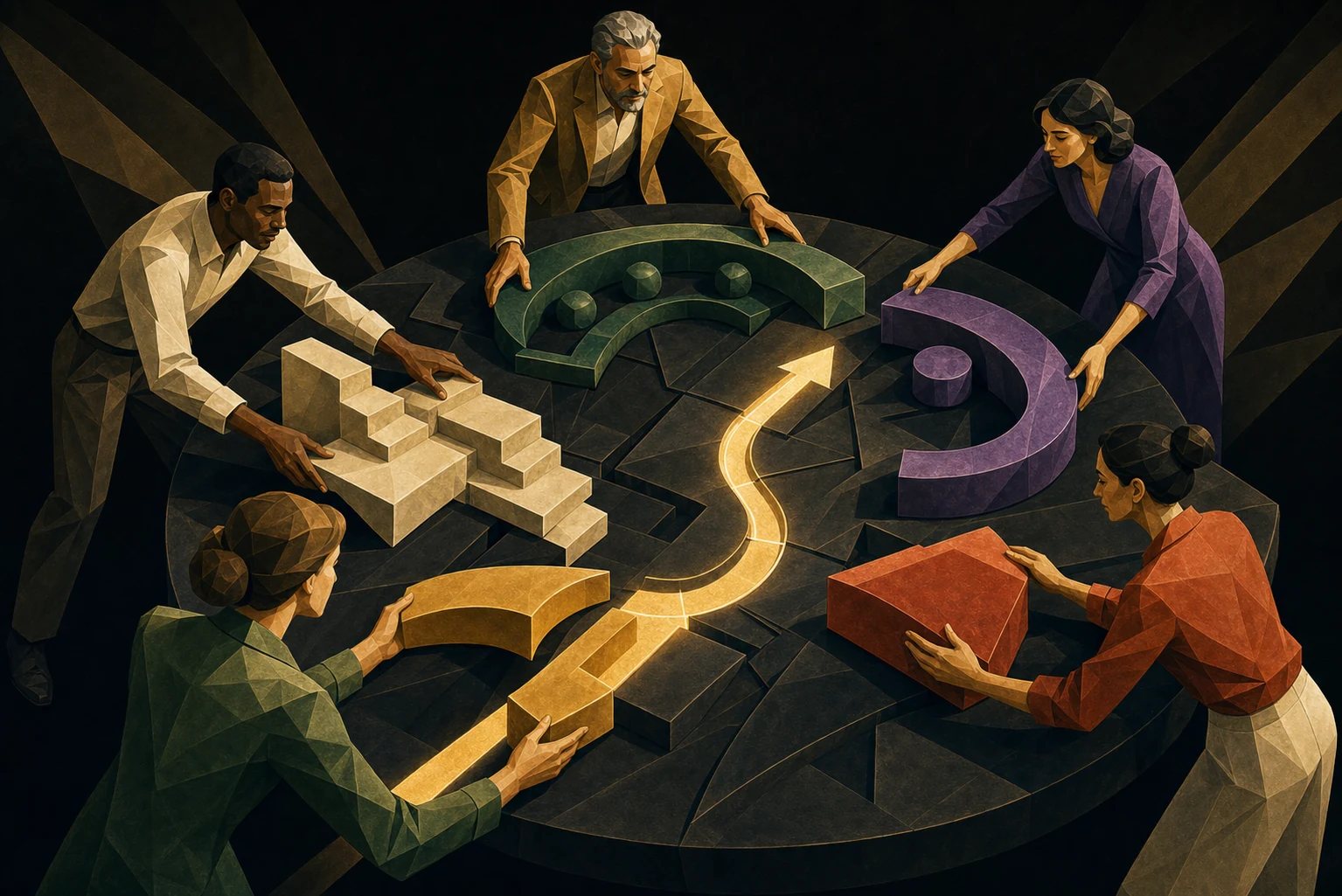
Ask a stalled organization where it’s stuck and you’ll get as many answers as people you ask. IT says legacy. Business says IT. Leadership says culture. Everyone is partly right, which is exactly the problem: you cannot fix what you cannot see together.
That’s why the first deliverable I produce in any engagement is not a strategy, a roadmap or a recommendation. It’s a map.
Why a map, and not another audit
Audits produce reports; reports get filed. A map is different — it’s a single visual that shows, on one surface, where the fog sits: the decisions without owners, the systems without users, the strategies that never became behavior, the places where alignment quietly breaks. You put it on the wall, people lean in, point, and — this is the crucial part — correct it. The corrections are where the truth lives.
I learned the power of this at SPW, the Walloon public administration. The program had to consolidate dozens of applications — countless technologies, stakeholders and UX approaches accumulated over years — into five. Five UX consultants had preceded me; the business refused further delays, so there would be no research phase, no user interviews, no data. Everything had to run in expert mode. The only viable first move was to make the ecosystem visible: what exists, what connects to what, who owns what, where flows break. Once that picture existed, a year’s plan practically wrote itself — not because the situation got simpler, but because everyone was finally looking at the same complexity.
At IRISnet, before we built anything, the same exercise exposed the real issue: a customer completing one task had to traverse multiple back-ends and interfaces — down to an Excel file on a shared drive — with error-prone manual steps between them. Drawn on one page, the absurdity became undeniable, and undeniable is what unlocks budgets. The map did more for alignment than any business case.
What goes on a Complexity Map
Not architecture diagrams — those show systems, and systems are rarely where organizations are stuck. A Complexity Map shows four layers on one canvas:
Decisions — what has been decided, by whom, and whether behavior follows. The decided-but-not-done items get marked in their own color. There are always more than leadership expects.
Flows — how the work actually travels: tasks, handoffs, workarounds, the unofficial Excel files. Not the process as documented; the process as lived.
People — who owns what, who blocks what, where the silences are. (Where do meetings go quiet? That belongs on the map.)
Knowledge — where the information needed for the work actually lives: systems, documents, or three veterans’ heads. With AI initiatives, this layer has become decisive — an agent is only as good as the context you can feed it, and this layer shows whether you can feed it at all.
The discipline is compression: everything on one surface, visible in one glance. The value isn’t precision — it’s sharedness. A 70%-accurate map that twelve stakeholders correct together beats a 95%-accurate report nobody reads.
What happens when people see it
The same thing, every time — and it’s the moment I do this work for. The room goes quiet, then someone says a sentence that begins with “So that’s why…”
Paralysis rarely comes from complexity itself. It comes from everyone holding a different partial picture of the complexity, and being politely unable to say so. The map removes that impossibility. Disagreements that lived comfortably in abstraction become impossible to sustain when both people are pointing at the same drawing. That’s when direction becomes possible — and direction, not analysis, is what a stuck organization is missing.
Fog thrives in the dark. Draw it, and it starts to lift.
Keep reading

AI Adoption • 16 Jun 2026 • EN
Pilot purgatory: why most AI pilots never reach production — and the one question that gets you out
Most AI pilots are designed to avoid the organisation rather than change it, which is exactly why they never cross into production. The one kickoff question that predicts whether yours will.
AI Adoption • 9 Jun 2026 • EN
The mistake organizations made with mobile in 2012 is the one they're making with AI in 2026
Replace mobile app with AI pilot and 2012 becomes 2026. A technology that changes how work flows cannot be adopted as an accessory to work that has not changed.
AI Adoption • 2 Jun 2026 • EN
Your AI roadmap is a lie. Here's what you actually need.
A three-year AI Gantt chart is not a plan, it is anxiety management. What replaces it: a direction people can see, the next verifiable step, and a cadence of honest re-decision.