Team Dynamics
What if we held AI upside down?
A reversal of perspective: what if AI is not a tool to master, but a mirror that reveals our cognitive blind spots?
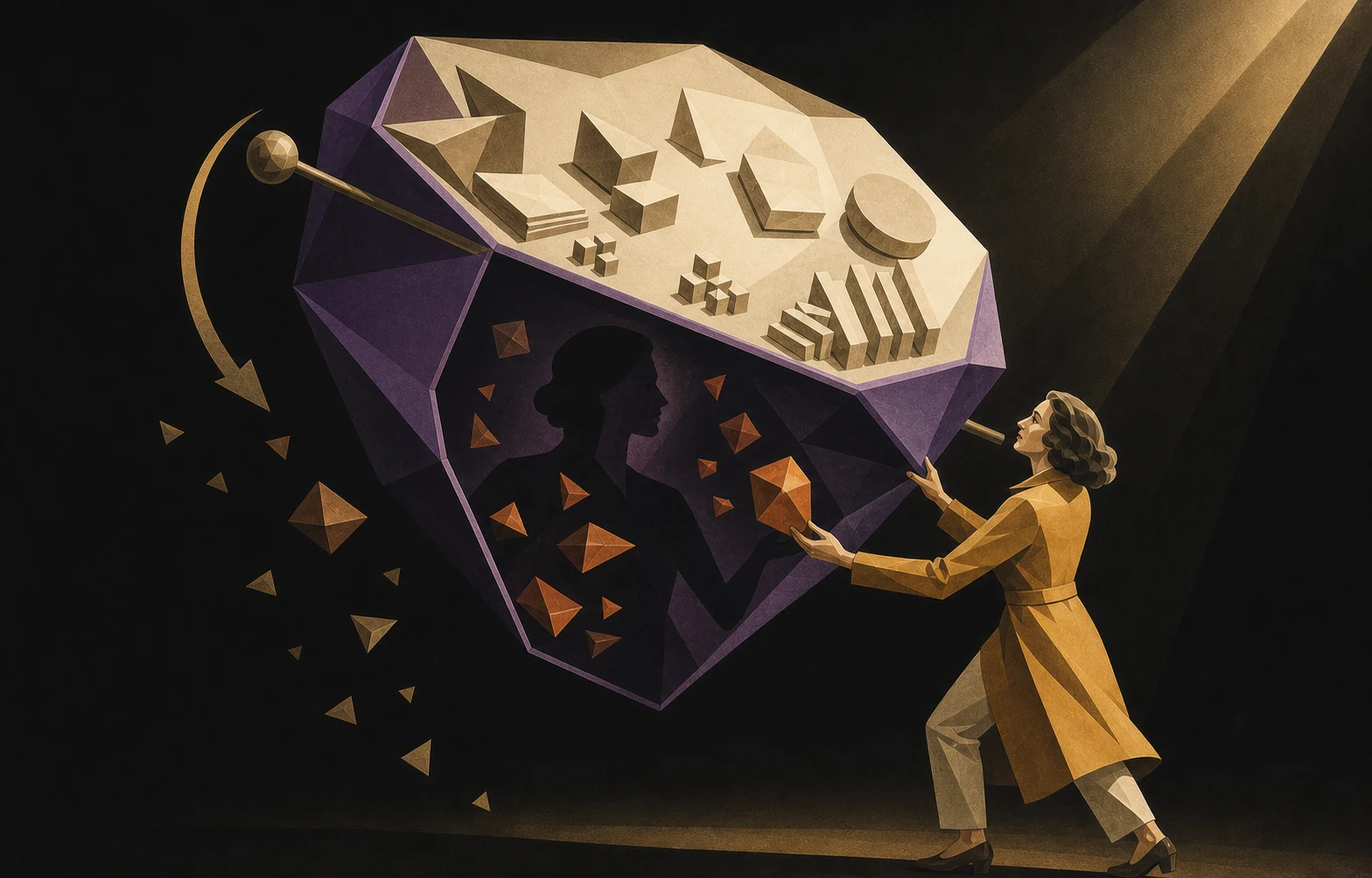
A useful provocation. Most teams approach AI as a new Swiss army knife - what can I do with it? This article proposes the inversion: what does AI allow me to see about myself that I could not see before?
The tool as mirror
When a colleague writes a poor prompt and receives a mediocre answer, the reflex is to blame the tool. That is a diagnostic error. The AI output reflects, with unsettling precision, the clarity of the intention going in. A team that learns to use AI is, in reality, learning to formulate what it wants.
But the mirror goes further than prompt quality. What follows is a free-ranging, practical reflection on how to strengthen — rather than atrophy — our brains in the age of generative models.
The compression reflex: a legacy of industrialism
Faced with AI, our first move is almost always the same: transcribe, summarize, extract. Turn hours of meetings into bullet points. Ask an LLM to shrink 300 pages into a one-page briefing.
The reflex seems obvious: save time, cut the noise, ship a deliverable. Except that, as several papers and studies seem to indicate (sources at the end of this article), our brain is not wired for linear optimization; it is wired for recursive exploration.
When we truncate complexity, we cut off the very oxygen of insight moments: those gamma flashes that only appear after a long cognitive simmer.
The anatomy of deep thinking: a short neuroscience detour
On one side, what the research says. On the other, what we often do with AI:
- Default mode network + frontoparietal network: the two fuse when we let our minds wander — and we force linearity, purging every tangent.
- Deep reading: it forges new neural circuits — and we replace it with one-paragraph executive summaries.
- Walking: +81% creativity thanks to noradrenaline — and we sit static in video meetings.
- The Japanese concept of ma: the value of the space between the notes — and we saturate our calendars, filling every silence with notifications.
The verdict? Messiness is not a bug; it is the premium feature of human cognition.
Realizing we use AI upside down
There are two ways to hold the tool:
- Compression: delegating the cognitive housekeeping to the machine.
- Expansion: inviting the machine to amplify the mental playing field.
I understood this during a twenty-five-minute voice-to-GPT session. No script, no SMART objective. Just a rambling conversation about a manuscript lying fallow.
The result: ideas I could never have typed — because they simply did not exist before being spoken, then reflected back by the model.
Cognitive choreography: three levels to hack your own brain
- Expansive exploration (voice) — suggested model: GPT-4o voice. Let things drift, bounce around. Human skill activated: curious naming, naming the unnamed.
- Mapping the terrain (reasoning) — suggested model: o3 or Gemini 2 Pro. Detect the patterns, the tensions, the implicit frames. Skill activated: terrain-reading.
- Strategic structuring (refinement) — suggested model: Claude Opus. Refine, build scenarios, test idea architectures. Skill activated: architectural thinking.
Key 1: changing models means changing dance partners.
Key 2: chain models the way you alternate brisk walking and interval training — cognitive performance is born in the variation.
A practical protocol to get started
- Pick a fuzzy territory. An issue you sense is crucial but ill-defined.
- Open voice mode for at least fifteen minutes. Speak without a filter. Let the AI probe, question the tone, feed your detours.
- Ask for a map, not a summary. For example: Here is the raw transcript. Show me the tensions, the tacit assumptions, and the conceptual branches.
- Read the map out loud — yes, again. Where are the gaps, the zones left uncovered? Which improbable connections deserve a deeper look?
- Refine with the right model. Need structure? Claude Opus. Need data? o3 with targeted RAG. Need creativity? Back to voice mode.
- Integrate and apply. Frameworks that emerge from your own exploration take root without a graft.
Why this is a massive competitive advantage
Companies obsessed with compression gain a few points of productivity. Those that bet on cognitive expansion create non-linear leaps in value: new products, unconventional strategies, learning cultures.
Efficiency is a natural limit. Imagination is exponential.
Three reversals to try this week
- Instead of asking “Can AI do X?”, ask “What does it say about my process that I want to delegate X?”
- Instead of evaluating the quality of the answer, evaluate the quality of the question.
- Instead of looking for the ideal tool, look for the friction the tool brings to light.
And to re-educate the reflex day to day: before opening ChatGPT, ask yourself whether you need speed… or depth. Block out time for intelligent idling with a voice model. And share your cognitive maps with your team — they are worth more than a sterile meeting recap.
Toward cognitive symbiosis, not mental outsourcing
The real bet is not whether AI will replace our neurons, but how we will rewire our neurons in its company. Each model is an invitation to widen our palette of intelligences: associative, critical, architectural.
What if the future of performance lay not in brevity, but in the capacity to stay with the essential questions for a long time?
I am pursuing this exploration in a book that is slowly taking shape. In the meantime, tell me: which of your ideas deserves a deep soak rather than a cold shower of summaries?
Ready, set, expand.
Sources: Nate B. Jones, We’re Using AI Backwards — Here’s How to Max Your Brain on AI · Emiram Kablo & Patricia Arias-Cabarcos, Privacy in the Age of Neurotechnology (ACM CCS 2023).
Keep reading
Team Dynamics • 23 Jun 2026 • EN
Some of your employees are quietly sabotaging your AI rollout. They have their reasons.
When employees quietly undermine an AI rollout, the boardroom asks who. The useful question is why. Resistance is feedback that could not find a safer channel, and it is readable.
Team Dynamics • 30 Jul 2025 • EN
Does AI force us to rethink how teams work?
When every member of a team has a copilot, roles, rituals, and work distribution begin to deform. How do we recompose them?