Team Dynamics
Some of your employees are quietly sabotaging your AI rollout. They have their reasons.
When employees quietly undermine an AI rollout, the boardroom asks who. The useful question is why. Resistance is feedback that could not find a safer channel, and it is readable.
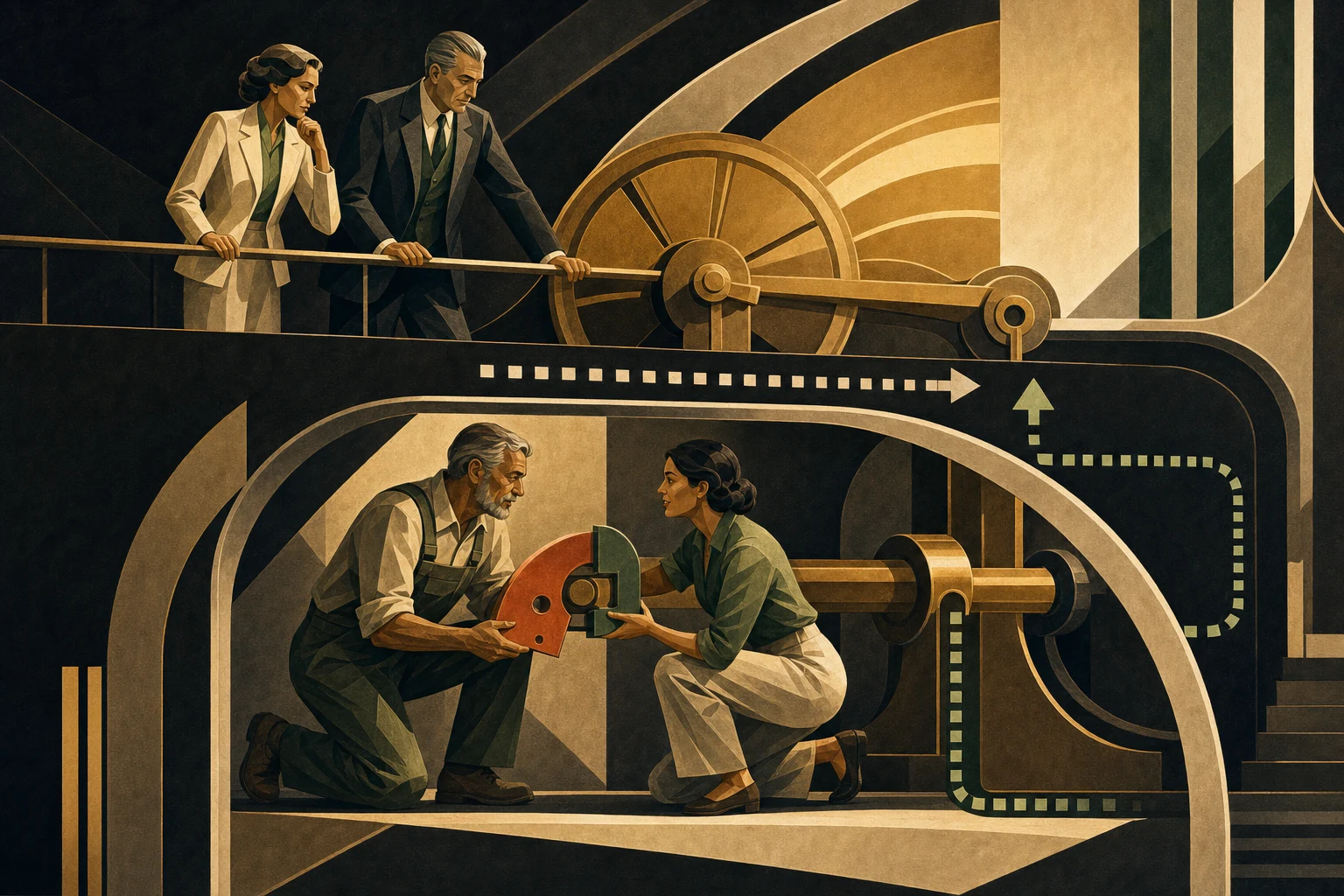
There’s a number circulating that most executives refuse to believe: in a 2026 survey by Writer, 29% of employees admitted to actively undermining their company’s AI efforts — refusing to use the tools, feeding them bad inputs, or quietly steering colleagues away. Among Gen Z respondents, the figure was reported at 44%.
The first reaction in every boardroom is the same: disbelief, then who? — as if the problem were disloyal individuals to be found and fixed.
Wrong question. In 26 years of technology transitions, I’ve learned to read resistance differently: sabotage is feedback that couldn’t find a safer channel.
Resistance is rational
Put yourself in the seat of the person resisting.
They’ve watched the announcement. They’ve heard that AI will “augment, not replace” them — from the same leadership that, in the same quarter, may be planning workforce reductions. They’ve noticed that the colleagues who master the tools get celebrated, while their own expertise — built over fifteen years — suddenly counts for less. Nobody has told them what their role looks like in three years, because nobody knows.
Now: is quietly declining to feed the machine that might obsolete you irrational? It’s the most rational move on the board. Fear of obsolescence, fear of losing control, fear of being exposed as incompetent — I’ve watched these same three fears surface in every wave since the early web. The technology changes; the fears never do. What changes is only whether leadership makes it safe to say them out loud.
When fear can be spoken, it becomes a requirement — something you can design for. When it can’t, it becomes behavior: missed trainings, tools “that don’t work for my cases,” data that somehow never gets entered. What looks like sabotage is fear that was denied a microphone.
The moment a skeptic flips
I’ve spent 15 years teaching and training alongside my consulting work — business schools, training centers, and lately AI upskilling in organizations. The most instructive person in any room is the skeptic in the back, arms crossed.
What flips a skeptic is never the feature list. In my experience it’s always one of two things: the moment the tool visibly saves them from something they hate doing — not something the vendor thinks is impressive — or the moment someone with authority says, credibly, what will not happen to them. Relevance and safety. Demos provide neither.
That’s why adoption metrics based on licenses and logins are theater. People can log in resentfully. What you want to measure is voluntary, repeated use on tasks that matter — and the only way to get it is to make the tool serve the person before it serves the KPI.
What to do with your 29%
Find the fear before you fight the behavior. Run sessions where the explicit question is “what worries you about this?” — anonymously if the culture requires it. You’ll get a design brief, not a complaint list. The worries map precisely onto what your rollout hasn’t addressed.
Answer the 3-year question. People aren’t asking whether AI is impressive; they’re asking what happens to them. If you can’t describe how roles evolve, say that honestly and describe how the answer will be built — with them. Vagueness reads as a verdict already reached.
Give the skeptics a job. The strongest resisters are often your most experienced people — the ones with the deepest process knowledge. Make them the testers, the edge-case finders, the ones who decide what the AI must prove. Resistance converts into rigor remarkably fast when it’s given authority instead of a lecture.
Stop celebrating only the enthusiasts. If visibility and promotions flow exclusively to the AI-fluent, you are structurally telling everyone else they’re the past. That message costs you 29% — or more.
The saboteurs aren’t your enemies. They’re your most honest measurement of how the transition actually feels from below deck. Organizations that treat resistance as data cross the wave. Organizations that treat it as disloyalty get to discover just how creative quiet resistance can be.
Sources
Keep reading

Team Dynamics • 21 Aug 2025 • EN
What if we held AI upside down?
A reversal of perspective: what if AI is not a tool to master, but a mirror that reveals our cognitive blind spots?

Team Dynamics • 30 Jul 2025 • EN
Does AI force us to rethink how teams work?
When every member of a team has a copilot, roles, rituals, and work distribution begin to deform. How do we recompose them?